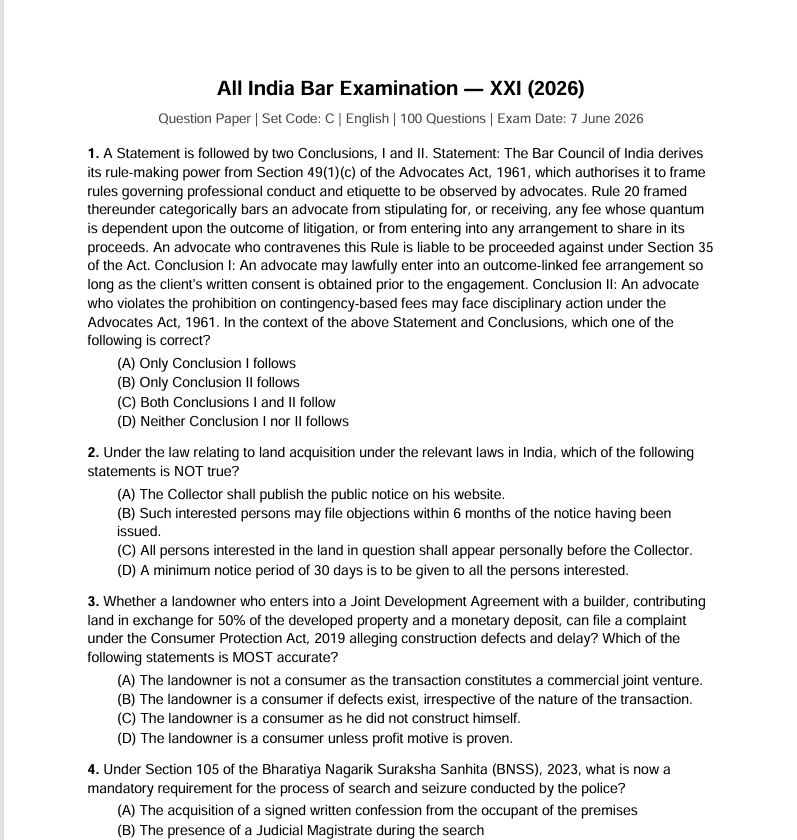
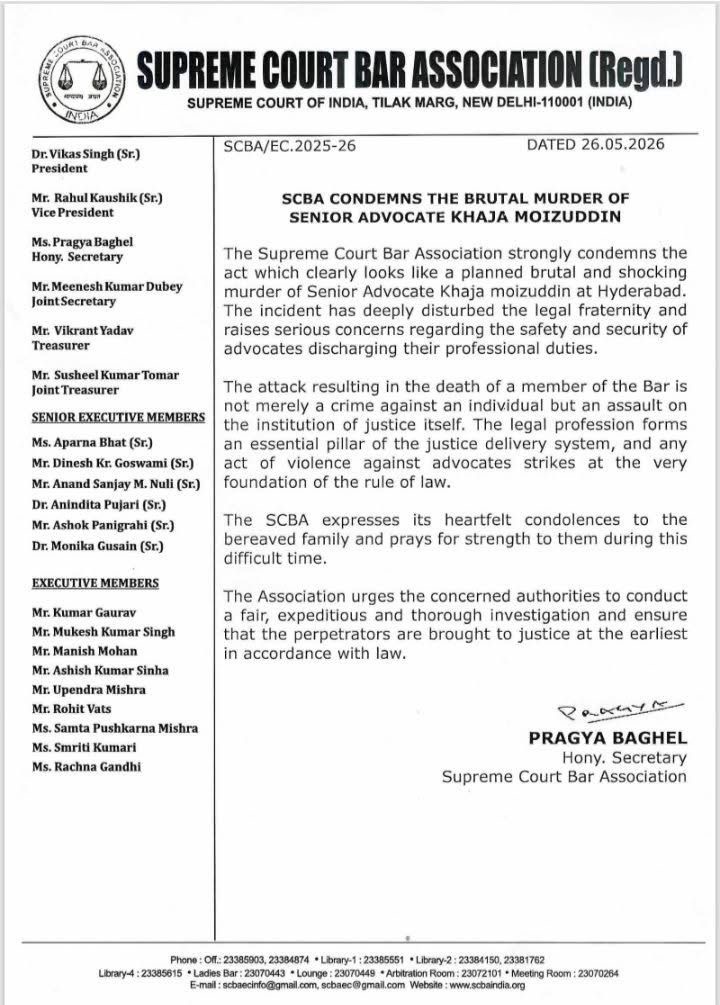
Bar Council Updates
›
Bar Council of India
›
AIBE 21 Answer Key 2026 (Set C) - Unofficial Key with E...
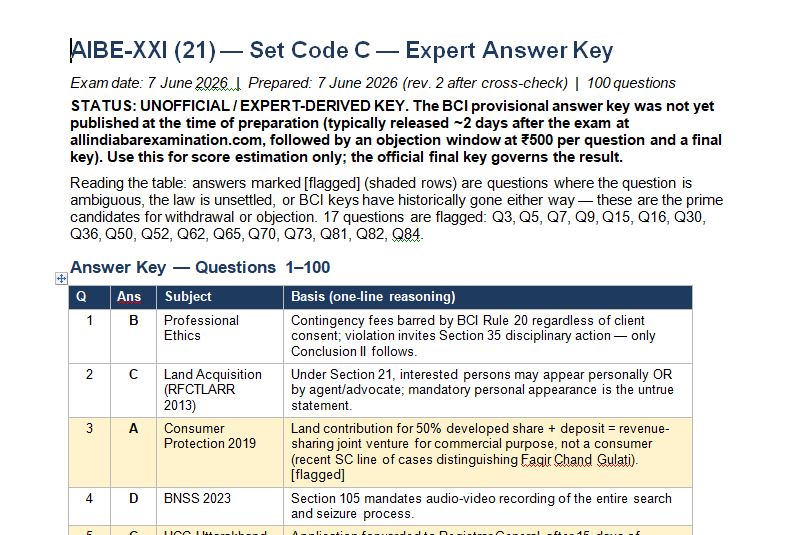
⛶ Tap to zoom
legistro.com
legistro.com
tap anywhere to close
AIBE 21 Answer Key 2026 (Set C) - Unofficial Key with Explanations
Unofficial question-wise answer key for AIBE 21 Set C held on 7 June 2026, with act and section references for all 100 questions and a list of disputed questions. Official BCI provisional key expected 9-10 June. Updated as official keys release.
AIBE-XXI (21) - SET C - UNOFFICIAL ANSWER KEY WITH EXPLANATIONS
Exam date: 7 June 2026 | Prepared: 7 June 2026 (rev. 3) | 100 questions
Status: Unofficial, expert-derived key for score estimation only. The BCI provisional answer key is expected around 9-10 June 2026 at allindiabarexamination.com, followed by an objection window (Rs. 500 per question, refundable if accepted) and a final key. Results are based only on BCI's final key.
Questions marked [DISPUTED] are ambiguous or have conflicting authority and are the prime candidates for objections or withdrawal. Disputed questions: Q2, Q3, Q5, Q7, Q9, Q15, Q16, Q30, Q36, Q50, Q52, Q62, Q65, Q70, Q73, Q81, Q82, Q84.
Q1. Answer: B
Subject: Professional Ethics
Reason: Contingency fees barred by BCI Rule 20 regardless of client consent; violation invites Section 35 disciplinary action - only Conclusion II follows.
Q2. Answer: C [DISPUTED]
Subject: Land Acquisition (RFCTLARR 2013)
Reason: Under Section 21, interested persons may appear personally OR by agent/advocate; mandatory personal appearance is the untrue statement. (Disputed: some keys treat the 6-month objection option as the untrue statement instead.)
Q3. Answer: A [DISPUTED]
Subject: Consumer Protection 2019
Reason: Land contribution for 50% developed share + deposit = revenue-sharing joint venture for commercial purpose, not a consumer (recent SC line of cases distinguishing Faqir Chand Gulati).
Q4. Answer: D
Subject: BNSS 2023
Reason: Section 105 mandates audio-video recording of the entire search and seizure process.
Q5. Answer: A [DISPUTED]
Subject: UCC Uttarakhand Rules 2025
Reason: Application forwarded to the Registrar General after 30 days of Registrar inaction per the UCC Rules escalation timeline (sources differ between 15 and 30 days).
Q6. Answer: A
Subject: CrPC
Reason: Section 125 - summary maintenance remedy for spouses, children and parents.
Q7. Answer: B [DISPUTED]
Subject: Companies Act 2013
Reason: Fast track merger (S.233): approval by Regional Director (Central Government delegate), 60-90 day timeline - not NCLT.
Q8. Answer: B
Subject: CrPC
Reason: S.374(3) - appeal from a sentence by a Magistrate of the second class lies to the Court of Session.
Q9. Answer: C [DISPUTED]
Subject: BNSS 2023
Reason: Intimation to informant of decision not to investigate - 14 days is the expected key.
Q10. Answer: C
Subject: Constitution / Art 21
Reason: Parmanand Katara v. UOI = right to emergency medical care; doctors must treat without waiting for legal formalities.
Q11. Answer: B
Subject: Torts
Reason: The needle left behind after surgery is straightforward medical negligence with no pre-existing vulnerability of the victim, so it is NOT an eggshell-skull example; the other scenarios involve hidden susceptibility or liability for the full extent of foreseeable shock.
Q12. Answer: D
Subject: CPC
Reason: Order IX Rule 13 - both A and R true, R is the correct explanation.
Q13. Answer: A
Subject: CrPC
Reason: Section 57 - person arrested without warrant cannot be detained beyond 24 hours without Magistrate's authority.
Q14. Answer: D
Subject: Land Acquisition
Reason: For Scheduled Tribes land, SIA and Gram Sabha consent are mandatory; acquisition cannot proceed without consent.
Q15. Answer: C [DISPUTED]
Subject: Constitutional Law
Reason: Multiple keys credit Prof. Abram Chayes with first using the term in American public-law scholarship; Justice P.N. Bhagwati pioneered PIL in India, so this remains disputed.
Q16. Answer: C [DISPUTED]
Subject: Jurisprudence
Reason: Jus Naturale - the Roman natural-law idea of a higher law binding all, closest analogue to the Rule of Law.
Q17. Answer: A
Subject: Constitution / Puttaswamy
Reason: A is true (privacy read into Art 21); R is false - privacy is not expressly enumerated in Part III.
Q18. Answer: A
Subject: Specific Relief Act
Reason: Lumley v. Wagner principle - injunction may enforce the negative covenant (S.42); court cannot compel singing.
Q19. Answer: C
Subject: Constitution
Reason: Residuary legislative power vests in Parliament (Art 248 r/w Entry 97, List I).
Q20. Answer: B
Subject: Administrative Law
Reason: First Administrative Reforms Commission (1966) first recommended the Lokpal/Ombudsman in its interim report.
Q21. Answer: D
Subject: Professional Ethics
Reason: Harish Chandra Tiwari v. Baiju - misappropriation of client money is among the gravest misconduct, ordinarily warranting removal from the roll.
Q22. Answer: A
Subject: Evidence
Reason: Sharad Birdhichand Sarda v. State of Maharashtra - the five golden principles (panchsheel) of circumstantial evidence.
Q23. Answer: D
Subject: BNSS 2023
Reason: Plea bargaining application within 30 days of framing of charge (S.290).
Q24. Answer: A
Subject: Christian Marriage Act 1872
Reason: Marriage to be solemnized between 6 a.m. and 7 p.m. (S.10).
Q25. Answer: C
Subject: Arbitration Act 1996
Reason: S.25(b) - on respondent's default in filing defence, tribunal continues proceedings without treating it as an admission.
Q26. Answer: B
Subject: IPC
Reason: S.120A - mere agreement suffices where the object is an offence punishable with death or rigorous imprisonment (proviso requires overt act only otherwise).
Q27. Answer: C
Subject: Evidence / Maxims
Reason: Onus probandi = burden of proof - responsibility on the party making an affirmative claim.
Q28. Answer: B
Subject: Constitution
Reason: Pension cut-off date classification challenges attract Article 14 and the doctrine of reasonable classification (D.S. Nakara).
Q29. Answer: B
Subject: Guardians & Wards Act 1890
Reason: S.19 - guardian may be appointed for a married female minor only where the husband is, in the court's opinion, unfit.
Q30. Answer: C [DISPUTED]
Subject: Contract Act
Reason: S.135 - extension of time to the principal debtor without the surety's consent discharges the surety entirely, so Y is not liable at all (the option's stated reason is loosely worded, but the outcome is correct).
Q31. Answer: B
Subject: Patents Act 1970
Reason: S.100 - Government may use a patented invention for its own purposes without the patentee's consent.
Q32. Answer: A
Subject: Contract Act
Reason: Trading with an alien enemy during war is void as against public policy; routing via intermediary does not cure it.
Q33. Answer: D
Subject: Habeas Corpus
Reason: Lord Wright's observation appears in Greene v. Secretary of State for Home Affairs (1942) AC 284.
Q34. Answer: A
Subject: Transfer of Property Act
Reason: Condition in the same document = mortgage by conditional sale (S.58(c) proviso); B must seek foreclosure through court.
Q35. Answer: A
Subject: Constitution
Reason: Air Act 1981 was enacted under Article 253 to implement the Stockholm Conference decisions.
Q36. Answer: C [DISPUTED]
Subject: Evidence / S.65B
Reason: Navjot Sandhu stands overruled by Anvar and Arjun Panditrao Khotkar - electronic records cannot be admitted without the S.65B(4) certificate, so (C) is no longer a true statement of law.
Q37. Answer: B
Subject: CPC
Reason: Order IX Rule 2 - failure to pay court fee/postal charges for summons: court may dismiss the suit.
Q38. Answer: D
Subject: CPC
Reason: Order XXI Rule 58 - claims/objections to attachment are adjudicated by the executing court itself.
Q39. Answer: A
Subject: BSA 2023
Reason: S.2 framework recognises 'may presume', 'shall presume' and 'conclusive proof' - 'unassailable proof' is not part of it.
Q40. Answer: B
Subject: Companies Act 2013
Reason: Both remedies coexist: class action under S.245 and individual oppression/mismanagement relief under S.241.
Q41. Answer: B
Subject: Advocates Act 1961
Reason: S.9(1) - Disciplinary Committee of three: two elected from the Council, one co-opted advocate (non-member) with prescribed qualifications.
Q42. Answer: C
Subject: CPC
Reason: Order VI Rule 16 - court may strike out unnecessary/prejudicial pleadings at any stage.
Q43. Answer: D
Subject: BCI Rules
Reason: Rule 8 - advocate cannot appear for/against an institution of whose Executive Committee he is a member.
Q44. Answer: B
Subject: Dowry Prohibition Act
Reason: S.6 - dowry received before marriage must be transferred to the woman within three months of the date of marriage.
Q45. Answer: D
Subject: CrPC
Reason: S.167(2) - default bail after 60 or 90 days depending on the maximum punishment for the offence.
Q46. Answer: D
Subject: BNS 2023
Reason: Community Service is the newly added punishment under S.4.
Q47. Answer: A
Subject: Evidence / Juvenility
Reason: Statutory documents (birth certificate, school records) take precedence; ossification is a last resort and not conclusive - only Statement II is true.
Q48. Answer: D
Subject: CPC
Reason: Order XXII Rule 9 - abatement set aside on proof of sufficient cause for not applying in time.
Q49. Answer: B
Subject: IT Act 2000
Reason: Electronic record covers digital data, electronically stored/sent image or sound, and microfilm/microfiche (I, II, III); paper-only records are excluded.
Q50. Answer: B [DISPUTED]
Subject: BSA 2023
Reason: S.63(4)/Schedule require signatures of the person in charge and an expert plus the hash value - the expert's qualifications are not a stated requirement.
Q51. Answer: B
Subject: IT Act 2000
Reason: Criminal liability (S.66) attaches when the S.43 act is done dishonestly or fraudulently; mere unauthorised access is civil (compensation).
Q52. Answer: C [DISPUTED]
Subject: IPC
Reason: S.362 abduction - force or deceit + inducement to move are the ingredients; the abducted person need not be a minor.
Q53. Answer: B
Subject: Specific Relief Act
Reason: S.20(2) - substituted performance requires a prior written notice of not less than 30 days to the party in breach; A hired C 'immediately' without notice, so the Rs. 10 lakh cannot be recovered via this route.
Q54. Answer: B
Subject: Motor Vehicles Act
Reason: PUC certificate - S.190(2) MV Act read with Rules 115 & 116, Central Motor Vehicles Rules 1989.
Q55. Answer: B
Subject: Arbitration Act 1996
Reason: S.5 - judicial intervention only where the Act expressly permits.
Q56. Answer: B
Subject: CPC
Reason: Order XXIII - I, II and III are correct; the court is not bound to grant permission whenever asked (IV is wrong).
Q57. Answer: B
Subject: CPC
Reason: Defendant not served may apply to set aside the ex parte decree (Order IX Rule 13).
Q58. Answer: C
Subject: CPC
Reason: S.35B - costs imposed as a condition precedent to further prosecution of the suit/defence.
Q59. Answer: A
Subject: Constitution
Reason: Article 143 advisory opinions are advisory in nature and not strictly binding.
Q60. Answer: A
Subject: BNSS 2023
Reason: BNSS came into force on July 1, 2024.
Q61. Answer: B
Subject: Income-tax Act
Reason: S.10(37) - compensation on compulsory acquisition of urban agricultural land is exempt subject to prescribed conditions.
Q62. Answer: B [DISPUTED]
Subject: BSA 2023
Reason: Maps, inscriptions and caricatures are expressly illustrated as documents; 'private papers' as a class is not.
Q63. Answer: C
Subject: BNSS 2023
Reason: Judgment within 30 days of completing arguments, extendable to 45 days for recorded reasons.
Q64. Answer: C
Subject: BNS 2023
Reason: 'Terrorist act' integrated into general penal law via Section 113 BNS.
Q65. Answer: C [DISPUTED]
Subject: Special Marriage Act 1954
Reason: Fine up to one thousand rupees for printing/publishing matter relating to in-camera proceedings.
Q66. Answer: C
Subject: Income-tax Act
Reason: S.56(2)(x) - sums received without consideration above the threshold are taxable as 'Income from Other Sources'.
Q67. Answer: C
Subject: Minimum Wages Act 1948
Reason: S.5(2) - wages take effect from the specified date; if none, on expiry of three months from issue of the notification - both conclusions follow.
Q68. Answer: D
Subject: CrPC
Reason: 'Bailable offence' is defined in Section 2(a).
Q69. Answer: D
Subject: Income-tax Act
Reason: Both true; previous-year income assessed in the succeeding assessment year is exactly why tax is levied on previous-year income - R explains A.
Q70. Answer: B [DISPUTED]
Subject: BNS 2023
Reason: Forfeiture of property is most prominently applied to Organized Crime (S.111).
Q71. Answer: D
Subject: Income-tax Act
Reason: S.80D - medical insurance deduction allowed subject to prescribed limits and conditions.
Q72. Answer: D
Subject: Dowry Prohibition Act
Reason: S.3 - giving/taking dowry: imprisonment not less than five years.
Q73. Answer: A [DISPUTED]
Subject: Administrative Law
Reason: A.K. Kraipak v. UOI - natural justice freed from the confines of quasi-judicial functions and extended to administrative action (Ridge v. Baldwin is the arguable alternative).
Q74. Answer: A
Subject: Constitution
Reason: I and II are correct (Kesavananda; Ninth Schedule post-24.4.1973 open to basic-structure review per I.R. Coelho); III is wrong - amending power is not unlimited.
Q75. Answer: A
Subject: Environment Protection Act
Reason: S.3(2)(ii) is specifically the planning and execution of a nation-wide programme for prevention, control and abatement of pollution.
Q76. Answer: C
Subject: Parsi Marriage & Divorce Act
Reason: Maintenance may be awarded for a term not exceeding the life of the plaintiff.
Q77. Answer: C
Subject: Negotiable Instruments / Contract
Reason: 18-year-old of sound mind is fully competent; the promissory note is valid and A is liable.
Q78. Answer: A
Subject: Labour Law
Reason: IR Code 2020 subsumes the ID Act 1947, Trade Unions Act 1926 and IESO Act 1946 - not the IDR Act 1951.
Q79. Answer: D
Subject: Administrative Law
Reason: The quoted agency-centred definition emphasising judicial review is K.C. Davis's.
Q80. Answer: B
Subject: CPC
Reason: Order I Rule 10 - court may permit substitution or addition of the proper defendant.
Q81. Answer: C [DISPUTED]
Subject: Industrial Disputes Act
Reason: Per the Bangalore Water Supply triple test, the trust's organised, remunerated activities make it an 'industry' - R correctly explains A.
Q82. Answer: B [DISPUTED]
Subject: Transfer of Property Act
Reason: S.18 - transfers for the benefit of the public (advancement of knowledge) are exempt from the restrictions in Ss.14, 16 and 17, so the transfer including accumulation stands valid.
Q83. Answer: B
Subject: Motor Vehicles Act
Reason: HSRP pre-fitment on all new vehicles became mandatory from April 1, 2019.
Q84. Answer: A [DISPUTED]
Subject: Consumer Protection 2019
Reason: One-sided agreements constitute an unfair trade practice (Pioneer Urban v. Govindan Raghavan line, carried into CPA 2019).
Q85. Answer: A
Subject: Constitution
Reason: PUDR v. UOI (1982) expanded Article 23 - non-payment of minimum wages amounts to forced labour.
Q86. Answer: B
Subject: CPC
Reason: Inter-district transfer within a State (different districts) is ordered by the High Court (Ss.22-24).
Q87. Answer: C
Subject: Constitution
Reason: Article 253 - Parliament can legislate on State List subjects to implement international agreements.
Q88. Answer: A
Subject: Constitution
Reason: India follows functional, not rigid, separation of powers - both true and R is the correct explanation.
Q89. Answer: A
Subject: Arbitration Act 1996
Reason: S.16 kompetenz-kompetenz: tribunal may rule on its own jurisdiction; jurisdictional plea not later than the statement of defence - both true.
Q90. Answer: B
Subject: BNS 2023
Reason: Defamation (S.356) - simple imprisonment up to 2 years, or fine, or both, or community service.
Q91. Answer: C
Subject: BSA 2023
Reason: Like the Evidence Act, BSA does not apply to proceedings before an arbitrator/Arbitral Tribunal.
Q92. Answer: C
Subject: IPC
Reason: Theft (S.378) - moving movable property out of a person's possession without consent.
Q93. Answer: A
Subject: Hindu Adoptions & Maintenance Act
Reason: Wife's consent unnecessary where she has ceased to be a Hindu by conversion (also renunciation/unsoundness of mind).
Q94. Answer: C
Subject: Constitution
Reason: Relaxation of locus standi = the evolution of Public Interest Litigation.
Q95. Answer: A
Subject: Contract Act
Reason: S.27 - post-employment restraint of lawful profession is void (the three-year non-compete falls).
Q96. Answer: B
Subject: Constitution
Reason: During an Article 352 Proclamation, Parliament legislates on State List matters under Article 250.
Q97. Answer: A
Subject: IPC
Reason: S.100 - right of private defence of the body extends to causing death against assault with intent to kidnap or abduct.
Q98. Answer: C
Subject: Constitution
Reason: D.C. Wadhwa v. State of Bihar - re-promulgation of ordinances called a 'fraud on the Constitution'.
Q99. Answer: C
Subject: Copyright Act 1957
Reason: Posthumous works: 60 years from the year following first publication; 'publication' = making available by issue of copies or communication to the public - both true.
Q100. Answer: C
Subject: Arbitration Act 1996
Reason: S.20(2) - failing agreement, tribunal determines the place having regard to the circumstances of the case, including the convenience of the parties.
Disclaimer: Prepared by practising advocates for guidance only. Not affiliated with the Bar Council of India. Verify against the official key at allindiabarexamination.com.
Exam date: 7 June 2026 | Prepared: 7 June 2026 (rev. 3) | 100 questions
Status: Unofficial, expert-derived key for score estimation only. The BCI provisional answer key is expected around 9-10 June 2026 at allindiabarexamination.com, followed by an objection window (Rs. 500 per question, refundable if accepted) and a final key. Results are based only on BCI's final key.
Questions marked [DISPUTED] are ambiguous or have conflicting authority and are the prime candidates for objections or withdrawal. Disputed questions: Q2, Q3, Q5, Q7, Q9, Q15, Q16, Q30, Q36, Q50, Q52, Q62, Q65, Q70, Q73, Q81, Q82, Q84.
Q1. Answer: B
Subject: Professional Ethics
Reason: Contingency fees barred by BCI Rule 20 regardless of client consent; violation invites Section 35 disciplinary action - only Conclusion II follows.
Q2. Answer: C [DISPUTED]
Subject: Land Acquisition (RFCTLARR 2013)
Reason: Under Section 21, interested persons may appear personally OR by agent/advocate; mandatory personal appearance is the untrue statement. (Disputed: some keys treat the 6-month objection option as the untrue statement instead.)
Q3. Answer: A [DISPUTED]
Subject: Consumer Protection 2019
Reason: Land contribution for 50% developed share + deposit = revenue-sharing joint venture for commercial purpose, not a consumer (recent SC line of cases distinguishing Faqir Chand Gulati).
Q4. Answer: D
Subject: BNSS 2023
Reason: Section 105 mandates audio-video recording of the entire search and seizure process.
Q5. Answer: A [DISPUTED]
Subject: UCC Uttarakhand Rules 2025
Reason: Application forwarded to the Registrar General after 30 days of Registrar inaction per the UCC Rules escalation timeline (sources differ between 15 and 30 days).
Q6. Answer: A
Subject: CrPC
Reason: Section 125 - summary maintenance remedy for spouses, children and parents.
Q7. Answer: B [DISPUTED]
Subject: Companies Act 2013
Reason: Fast track merger (S.233): approval by Regional Director (Central Government delegate), 60-90 day timeline - not NCLT.
Q8. Answer: B
Subject: CrPC
Reason: S.374(3) - appeal from a sentence by a Magistrate of the second class lies to the Court of Session.
Q9. Answer: C [DISPUTED]
Subject: BNSS 2023
Reason: Intimation to informant of decision not to investigate - 14 days is the expected key.
Q10. Answer: C
Subject: Constitution / Art 21
Reason: Parmanand Katara v. UOI = right to emergency medical care; doctors must treat without waiting for legal formalities.
Q11. Answer: B
Subject: Torts
Reason: The needle left behind after surgery is straightforward medical negligence with no pre-existing vulnerability of the victim, so it is NOT an eggshell-skull example; the other scenarios involve hidden susceptibility or liability for the full extent of foreseeable shock.
Q12. Answer: D
Subject: CPC
Reason: Order IX Rule 13 - both A and R true, R is the correct explanation.
Q13. Answer: A
Subject: CrPC
Reason: Section 57 - person arrested without warrant cannot be detained beyond 24 hours without Magistrate's authority.
Q14. Answer: D
Subject: Land Acquisition
Reason: For Scheduled Tribes land, SIA and Gram Sabha consent are mandatory; acquisition cannot proceed without consent.
Q15. Answer: C [DISPUTED]
Subject: Constitutional Law
Reason: Multiple keys credit Prof. Abram Chayes with first using the term in American public-law scholarship; Justice P.N. Bhagwati pioneered PIL in India, so this remains disputed.
Q16. Answer: C [DISPUTED]
Subject: Jurisprudence
Reason: Jus Naturale - the Roman natural-law idea of a higher law binding all, closest analogue to the Rule of Law.
Q17. Answer: A
Subject: Constitution / Puttaswamy
Reason: A is true (privacy read into Art 21); R is false - privacy is not expressly enumerated in Part III.
Q18. Answer: A
Subject: Specific Relief Act
Reason: Lumley v. Wagner principle - injunction may enforce the negative covenant (S.42); court cannot compel singing.
Q19. Answer: C
Subject: Constitution
Reason: Residuary legislative power vests in Parliament (Art 248 r/w Entry 97, List I).
Q20. Answer: B
Subject: Administrative Law
Reason: First Administrative Reforms Commission (1966) first recommended the Lokpal/Ombudsman in its interim report.
Q21. Answer: D
Subject: Professional Ethics
Reason: Harish Chandra Tiwari v. Baiju - misappropriation of client money is among the gravest misconduct, ordinarily warranting removal from the roll.
Q22. Answer: A
Subject: Evidence
Reason: Sharad Birdhichand Sarda v. State of Maharashtra - the five golden principles (panchsheel) of circumstantial evidence.
Q23. Answer: D
Subject: BNSS 2023
Reason: Plea bargaining application within 30 days of framing of charge (S.290).
Q24. Answer: A
Subject: Christian Marriage Act 1872
Reason: Marriage to be solemnized between 6 a.m. and 7 p.m. (S.10).
Q25. Answer: C
Subject: Arbitration Act 1996
Reason: S.25(b) - on respondent's default in filing defence, tribunal continues proceedings without treating it as an admission.
Q26. Answer: B
Subject: IPC
Reason: S.120A - mere agreement suffices where the object is an offence punishable with death or rigorous imprisonment (proviso requires overt act only otherwise).
Q27. Answer: C
Subject: Evidence / Maxims
Reason: Onus probandi = burden of proof - responsibility on the party making an affirmative claim.
Q28. Answer: B
Subject: Constitution
Reason: Pension cut-off date classification challenges attract Article 14 and the doctrine of reasonable classification (D.S. Nakara).
Q29. Answer: B
Subject: Guardians & Wards Act 1890
Reason: S.19 - guardian may be appointed for a married female minor only where the husband is, in the court's opinion, unfit.
Q30. Answer: C [DISPUTED]
Subject: Contract Act
Reason: S.135 - extension of time to the principal debtor without the surety's consent discharges the surety entirely, so Y is not liable at all (the option's stated reason is loosely worded, but the outcome is correct).
Q31. Answer: B
Subject: Patents Act 1970
Reason: S.100 - Government may use a patented invention for its own purposes without the patentee's consent.
Q32. Answer: A
Subject: Contract Act
Reason: Trading with an alien enemy during war is void as against public policy; routing via intermediary does not cure it.
Q33. Answer: D
Subject: Habeas Corpus
Reason: Lord Wright's observation appears in Greene v. Secretary of State for Home Affairs (1942) AC 284.
Q34. Answer: A
Subject: Transfer of Property Act
Reason: Condition in the same document = mortgage by conditional sale (S.58(c) proviso); B must seek foreclosure through court.
Q35. Answer: A
Subject: Constitution
Reason: Air Act 1981 was enacted under Article 253 to implement the Stockholm Conference decisions.
Q36. Answer: C [DISPUTED]
Subject: Evidence / S.65B
Reason: Navjot Sandhu stands overruled by Anvar and Arjun Panditrao Khotkar - electronic records cannot be admitted without the S.65B(4) certificate, so (C) is no longer a true statement of law.
Q37. Answer: B
Subject: CPC
Reason: Order IX Rule 2 - failure to pay court fee/postal charges for summons: court may dismiss the suit.
Q38. Answer: D
Subject: CPC
Reason: Order XXI Rule 58 - claims/objections to attachment are adjudicated by the executing court itself.
Q39. Answer: A
Subject: BSA 2023
Reason: S.2 framework recognises 'may presume', 'shall presume' and 'conclusive proof' - 'unassailable proof' is not part of it.
Q40. Answer: B
Subject: Companies Act 2013
Reason: Both remedies coexist: class action under S.245 and individual oppression/mismanagement relief under S.241.
Q41. Answer: B
Subject: Advocates Act 1961
Reason: S.9(1) - Disciplinary Committee of three: two elected from the Council, one co-opted advocate (non-member) with prescribed qualifications.
Q42. Answer: C
Subject: CPC
Reason: Order VI Rule 16 - court may strike out unnecessary/prejudicial pleadings at any stage.
Q43. Answer: D
Subject: BCI Rules
Reason: Rule 8 - advocate cannot appear for/against an institution of whose Executive Committee he is a member.
Q44. Answer: B
Subject: Dowry Prohibition Act
Reason: S.6 - dowry received before marriage must be transferred to the woman within three months of the date of marriage.
Q45. Answer: D
Subject: CrPC
Reason: S.167(2) - default bail after 60 or 90 days depending on the maximum punishment for the offence.
Q46. Answer: D
Subject: BNS 2023
Reason: Community Service is the newly added punishment under S.4.
Q47. Answer: A
Subject: Evidence / Juvenility
Reason: Statutory documents (birth certificate, school records) take precedence; ossification is a last resort and not conclusive - only Statement II is true.
Q48. Answer: D
Subject: CPC
Reason: Order XXII Rule 9 - abatement set aside on proof of sufficient cause for not applying in time.
Q49. Answer: B
Subject: IT Act 2000
Reason: Electronic record covers digital data, electronically stored/sent image or sound, and microfilm/microfiche (I, II, III); paper-only records are excluded.
Q50. Answer: B [DISPUTED]
Subject: BSA 2023
Reason: S.63(4)/Schedule require signatures of the person in charge and an expert plus the hash value - the expert's qualifications are not a stated requirement.
Q51. Answer: B
Subject: IT Act 2000
Reason: Criminal liability (S.66) attaches when the S.43 act is done dishonestly or fraudulently; mere unauthorised access is civil (compensation).
Q52. Answer: C [DISPUTED]
Subject: IPC
Reason: S.362 abduction - force or deceit + inducement to move are the ingredients; the abducted person need not be a minor.
Q53. Answer: B
Subject: Specific Relief Act
Reason: S.20(2) - substituted performance requires a prior written notice of not less than 30 days to the party in breach; A hired C 'immediately' without notice, so the Rs. 10 lakh cannot be recovered via this route.
Q54. Answer: B
Subject: Motor Vehicles Act
Reason: PUC certificate - S.190(2) MV Act read with Rules 115 & 116, Central Motor Vehicles Rules 1989.
Q55. Answer: B
Subject: Arbitration Act 1996
Reason: S.5 - judicial intervention only where the Act expressly permits.
Q56. Answer: B
Subject: CPC
Reason: Order XXIII - I, II and III are correct; the court is not bound to grant permission whenever asked (IV is wrong).
Q57. Answer: B
Subject: CPC
Reason: Defendant not served may apply to set aside the ex parte decree (Order IX Rule 13).
Q58. Answer: C
Subject: CPC
Reason: S.35B - costs imposed as a condition precedent to further prosecution of the suit/defence.
Q59. Answer: A
Subject: Constitution
Reason: Article 143 advisory opinions are advisory in nature and not strictly binding.
Q60. Answer: A
Subject: BNSS 2023
Reason: BNSS came into force on July 1, 2024.
Q61. Answer: B
Subject: Income-tax Act
Reason: S.10(37) - compensation on compulsory acquisition of urban agricultural land is exempt subject to prescribed conditions.
Q62. Answer: B [DISPUTED]
Subject: BSA 2023
Reason: Maps, inscriptions and caricatures are expressly illustrated as documents; 'private papers' as a class is not.
Q63. Answer: C
Subject: BNSS 2023
Reason: Judgment within 30 days of completing arguments, extendable to 45 days for recorded reasons.
Q64. Answer: C
Subject: BNS 2023
Reason: 'Terrorist act' integrated into general penal law via Section 113 BNS.
Q65. Answer: C [DISPUTED]
Subject: Special Marriage Act 1954
Reason: Fine up to one thousand rupees for printing/publishing matter relating to in-camera proceedings.
Q66. Answer: C
Subject: Income-tax Act
Reason: S.56(2)(x) - sums received without consideration above the threshold are taxable as 'Income from Other Sources'.
Q67. Answer: C
Subject: Minimum Wages Act 1948
Reason: S.5(2) - wages take effect from the specified date; if none, on expiry of three months from issue of the notification - both conclusions follow.
Q68. Answer: D
Subject: CrPC
Reason: 'Bailable offence' is defined in Section 2(a).
Q69. Answer: D
Subject: Income-tax Act
Reason: Both true; previous-year income assessed in the succeeding assessment year is exactly why tax is levied on previous-year income - R explains A.
Q70. Answer: B [DISPUTED]
Subject: BNS 2023
Reason: Forfeiture of property is most prominently applied to Organized Crime (S.111).
Q71. Answer: D
Subject: Income-tax Act
Reason: S.80D - medical insurance deduction allowed subject to prescribed limits and conditions.
Q72. Answer: D
Subject: Dowry Prohibition Act
Reason: S.3 - giving/taking dowry: imprisonment not less than five years.
Q73. Answer: A [DISPUTED]
Subject: Administrative Law
Reason: A.K. Kraipak v. UOI - natural justice freed from the confines of quasi-judicial functions and extended to administrative action (Ridge v. Baldwin is the arguable alternative).
Q74. Answer: A
Subject: Constitution
Reason: I and II are correct (Kesavananda; Ninth Schedule post-24.4.1973 open to basic-structure review per I.R. Coelho); III is wrong - amending power is not unlimited.
Q75. Answer: A
Subject: Environment Protection Act
Reason: S.3(2)(ii) is specifically the planning and execution of a nation-wide programme for prevention, control and abatement of pollution.
Q76. Answer: C
Subject: Parsi Marriage & Divorce Act
Reason: Maintenance may be awarded for a term not exceeding the life of the plaintiff.
Q77. Answer: C
Subject: Negotiable Instruments / Contract
Reason: 18-year-old of sound mind is fully competent; the promissory note is valid and A is liable.
Q78. Answer: A
Subject: Labour Law
Reason: IR Code 2020 subsumes the ID Act 1947, Trade Unions Act 1926 and IESO Act 1946 - not the IDR Act 1951.
Q79. Answer: D
Subject: Administrative Law
Reason: The quoted agency-centred definition emphasising judicial review is K.C. Davis's.
Q80. Answer: B
Subject: CPC
Reason: Order I Rule 10 - court may permit substitution or addition of the proper defendant.
Q81. Answer: C [DISPUTED]
Subject: Industrial Disputes Act
Reason: Per the Bangalore Water Supply triple test, the trust's organised, remunerated activities make it an 'industry' - R correctly explains A.
Q82. Answer: B [DISPUTED]
Subject: Transfer of Property Act
Reason: S.18 - transfers for the benefit of the public (advancement of knowledge) are exempt from the restrictions in Ss.14, 16 and 17, so the transfer including accumulation stands valid.
Q83. Answer: B
Subject: Motor Vehicles Act
Reason: HSRP pre-fitment on all new vehicles became mandatory from April 1, 2019.
Q84. Answer: A [DISPUTED]
Subject: Consumer Protection 2019
Reason: One-sided agreements constitute an unfair trade practice (Pioneer Urban v. Govindan Raghavan line, carried into CPA 2019).
Q85. Answer: A
Subject: Constitution
Reason: PUDR v. UOI (1982) expanded Article 23 - non-payment of minimum wages amounts to forced labour.
Q86. Answer: B
Subject: CPC
Reason: Inter-district transfer within a State (different districts) is ordered by the High Court (Ss.22-24).
Q87. Answer: C
Subject: Constitution
Reason: Article 253 - Parliament can legislate on State List subjects to implement international agreements.
Q88. Answer: A
Subject: Constitution
Reason: India follows functional, not rigid, separation of powers - both true and R is the correct explanation.
Q89. Answer: A
Subject: Arbitration Act 1996
Reason: S.16 kompetenz-kompetenz: tribunal may rule on its own jurisdiction; jurisdictional plea not later than the statement of defence - both true.
Q90. Answer: B
Subject: BNS 2023
Reason: Defamation (S.356) - simple imprisonment up to 2 years, or fine, or both, or community service.
Q91. Answer: C
Subject: BSA 2023
Reason: Like the Evidence Act, BSA does not apply to proceedings before an arbitrator/Arbitral Tribunal.
Q92. Answer: C
Subject: IPC
Reason: Theft (S.378) - moving movable property out of a person's possession without consent.
Q93. Answer: A
Subject: Hindu Adoptions & Maintenance Act
Reason: Wife's consent unnecessary where she has ceased to be a Hindu by conversion (also renunciation/unsoundness of mind).
Q94. Answer: C
Subject: Constitution
Reason: Relaxation of locus standi = the evolution of Public Interest Litigation.
Q95. Answer: A
Subject: Contract Act
Reason: S.27 - post-employment restraint of lawful profession is void (the three-year non-compete falls).
Q96. Answer: B
Subject: Constitution
Reason: During an Article 352 Proclamation, Parliament legislates on State List matters under Article 250.
Q97. Answer: A
Subject: IPC
Reason: S.100 - right of private defence of the body extends to causing death against assault with intent to kidnap or abduct.
Q98. Answer: C
Subject: Constitution
Reason: D.C. Wadhwa v. State of Bihar - re-promulgation of ordinances called a 'fraud on the Constitution'.
Q99. Answer: C
Subject: Copyright Act 1957
Reason: Posthumous works: 60 years from the year following first publication; 'publication' = making available by issue of copies or communication to the public - both true.
Q100. Answer: C
Subject: Arbitration Act 1996
Reason: S.20(2) - failing agreement, tribunal determines the place having regard to the circumstances of the case, including the convenience of the parties.
Disclaimer: Prepared by practising advocates for guidance only. Not affiliated with the Bar Council of India. Verify against the official key at allindiabarexamination.com.
Published on Legistro.com
— India's advocate platform. See all Bar Council updates →